
May 4, 2026 · The Assaad Group
Moving to Texas from California — A 2026 DFW Relocation Guide for High-Income Families
By Kim Assaad and The Assaad Group at Compass
The California-to-Texas relocation flow has been one of the defining migration stories of the last decade, and it has not slowed down. The Texas Comptroller's domestic-migration data continues to show California as the single largest origin state for new Texas residents, with families, executives, and remote-work professionals moving for a combination of tax structure, cost of living, schools, and quality of life. Within Texas, the Dallas-Fort Worth metroplex absorbs the largest share of those moves outside of greater Austin and Houston.
This guide is written for high-income California families considering a move to DFW. It is not a generic "Texas vs. California" listicle. It covers the specific decisions that matter — which suburbs to evaluate, what your money actually buys, what the tax math looks like at a million dollars of household income, and the real friction points that surprise California buyers when they arrive.
The honest tax math at $1M+ household income
Texas's no-state-income-tax structure is the single most-discussed reason families move from California, and the math is more powerful than most buyers initially realize.
For a California resident earning $1M of W-2 income, California's top marginal rate (with the mental-health surtax) lands at roughly 13.3%. That same earner in Texas pays zero state income tax. The annualized delta is in the range of $100,000–$130,000 per year, depending on the breakdown of ordinary income vs. capital gains and the specific deductions in play. Compounded over a typical executive tenure of 5–10 years, the cumulative savings can easily exceed half a million dollars.
The asterisk: Texas property taxes are higher. Effective rates in DFW typically run 1.8%–2.5% depending on the specific city and the school district. On a $3M home, that's $54,000–$75,000 per year in property tax — meaningfully higher than what a similar-priced home would generate in California under Proposition 13's protected base.
The net math at $1M+ household income still favors Texas decisively, but the way the dollars flow is different. California families pay more to the state on income; Texas families pay more to the locality on property. For most high-income relocators, the Texas structure is preferable because:
- The income-tax savings outpace the property-tax differential at most home values
- Property taxes are deductible up to federal SALT cap (currently $10,000) — the rest is paid with after-tax dollars in both states
- Texas's lack of state income tax creates real flexibility on capital gains, equity comp exercises, and one-time liquidity events
Talk to your CPA before the move. Establishing Texas residency cleanly — and shedding California residency cleanly — matters. California's Franchise Tax Board is among the most aggressive in the country at challenging departure claims, especially for high earners with continuing California-source income.
The DFW "executive corridor" — where California families actually land
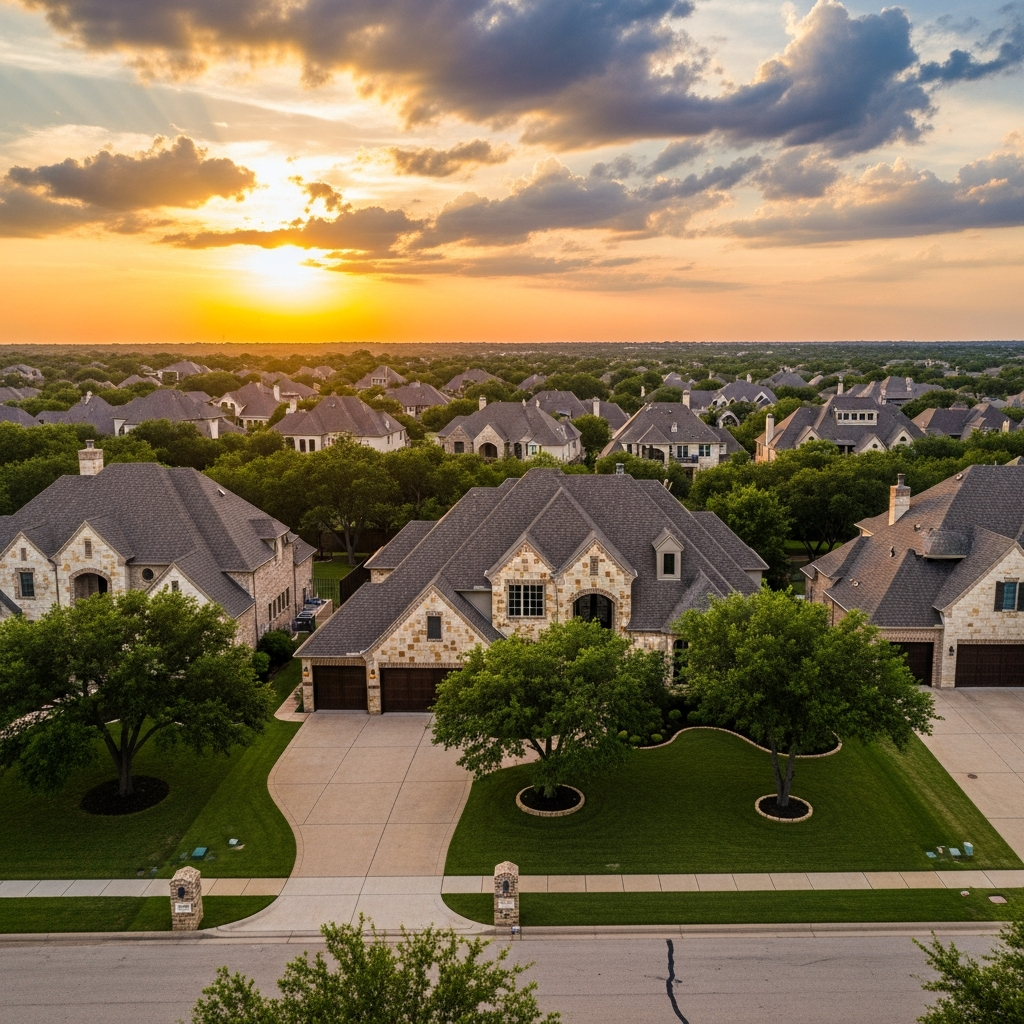
DFW is enormous. Families coming from coastal California cities almost always end up in a small set of communities within the metroplex that match the lifestyle profile they're leaving:
- Southlake — top-rated public schools (Carroll ISD), large lots, mature trees, walkable Town Square. The flagship destination for relocating executives with school-aged kids. Median home prices in the established estate corridors range from $1.5M to $5M+, with new construction in the high-end programs reaching $7M–$12M.
- Westlake — smaller, even more exclusive than Southlake, exceptional schools (Westlake Academy), and a higher concentration of $5M+ estates. Limited inventory.
- Highland Park / University Park (the Park Cities) — closer-in, urban-feel, walkable, top-tier private schools and a strong public school district (HPISD). For families who want the close-in equivalent of Pacific Heights or San Marino more than a suburban estate.
- Preston Hollow — large-lot Dallas neighborhood, traditionally the home of Dallas's old-line wealth. Houses range from refined ranch homes to substantial estates; lot premium is significant.
- Colleyville and Grapevine — adjacent to Southlake, slightly different price points, GCISD schools, more variety in housing stock and price.
- Flower Mound and Lantana — slightly further out, family-oriented, good schools, more accessible price points than the Southlake/Westlake core.
- Frisco / Prosper / McKinney — the northern corridor, growing rapidly, strong schools, newer construction, and the destination for many tech-and-finance relocators specifically.
For California families relocating with children of school age, the decision is most often between Southlake, Westlake, the Park Cities, and Frisco/Prosper. The Park Cities replicate the close-in coastal-California feel; Southlake and Westlake replicate the Marin/Atherton suburban-estate feel; Frisco and Prosper appeal to younger families wanting newer construction at lower price points.
What your money actually buys in DFW vs. California
This is the comparison that surprises California buyers most. A few reference points (all 2026):
| What you sold in California | Approximate DFW equivalent at the same price |
|---|---|
| $3M Bay Area mid-Peninsula 4-bed, 2,800 sq ft | $3M Southlake 6-bed, 6,000+ sq ft on a half-acre lot, modern finishes, three-car garage, pool |
| $5M Pacific Heights 3-bed condo | $5M Westlake or Highland Park estate, 7,000+ sq ft, formal grounds, premium school zoning |
| $2M LA Westside teardown | $2M turnkey Colleyville or Grapevine 5-bed, 4,500 sq ft, GCISD schools, established neighborhood |
| $8M Atherton 5,000 sq ft | $8M Westlake 10,000+ sq ft custom home, gated community, equestrian-grade lot, full amenity build |
These ranges shift quarter to quarter and are obviously generalizations. The single biggest adjustment California buyers make: you're paying for the school zoning and the community, not just the square footage. A home in the Carroll ISD school zone commands a premium over the same home a mile away in a different zone. Get that mapped before you tour.
Schools — the deciding factor for most California families
For families with children, schools are typically the central decision driver, and DFW offers a genuinely strong public-school option that California families with college-age and younger kids can take seriously.
- Carroll ISD (Southlake) — consistently top-ranked Texas school district. Carroll Senior High is among the highest-performing public high schools in the state.
- Westlake Academy (Westlake) — open-enrollment charter, IB curriculum, exceptional academic reputation.
- Highland Park ISD (Park Cities) — top-tier urban public district, strong arts and athletics, walkable campuses.
- Frisco ISD and Prosper ISD — large, growing, well-funded districts with strong outcomes; multiple high schools serving the corridor.
- GCISD (Grapevine-Colleyville) — strong district covering Colleyville and parts of Grapevine, often a value vs. Southlake.
DFW also has a strong private school market — St. Mark's, Hockaday, Greenhill, ESD (Episcopal School of Dallas), Trinity Valley — for families coming from Bay Area or LA private schools who want a similar trajectory. Tuition at DFW privates is meaningfully lower than at top Bay Area or LA equivalents.
Daily life — what actually changes
A few patterns we see in California families during their first year in DFW:
Driving. DFW is car-centric in a way coastal California is not, but commutes are faster and the metroplex is wider. Most executive corridors put you 25–35 minutes from DFW Airport, which is a meaningful quality-of-life upgrade for travel-heavy roles.
Weather. Summers are hot — multiple weeks above 100°F are normal. Winters are milder than the Northeast but cooler than coastal California, with occasional ice days. Tornado season exists but the median family experience is non-eventful — DFW is not a high-tornado zone like the Plains.
Outdoor lifestyle. This is the adjustment California families either embrace or struggle with. There is no Pacific coastline and no Sierra. There are excellent parks, water (Lake Grapevine, Lake Lewisville, Lake Texoma), golf, equestrian, and hiking, but the ecosystem is different. Families that orient around community sports, ranch ownership, fly-fishing, and weekend trips to Hill Country tend to thrive.
Food, culture, retail. Dallas in particular has a serious restaurant scene, top-tier cultural institutions (Dallas Museum of Art, Nasher Sculpture Center, Dallas Symphony, AT&T Performing Arts Center), and luxury retail (NorthPark Center, Highland Park Village). California families who feared a cultural step-down are usually pleasantly surprised.
Politics and community fit. Texas is politically different from California. Families with strong political identities should expect a different daily experience — schools, civic conversations, and neighborhood community feel different. This is rarely the dealbreaker California buyers initially worry it will be, but it's worth being honest about with yourself before the move, not after.
The mechanics of the move — what to time
For high-income relocators, the timing of the move materially affects the tax outcome. A few practical guidelines:
- Establish Texas residency cleanly. Texas driver's license, voter registration, primary home, banking, and ideally a homestead exemption application before the next tax year begins.
- Time large income events around the move. If you have an equity exercise, a bonus, or a liquidity event coming, the timing relative to your residency switch can move the tax bill by hundreds of thousands of dollars. Coordinate with your CPA.
- Don't keep one foot in California. California's FTB looks for "domicile indicators" — primary doctor, primary cars, kids' schools, days spent. The cleanest moves cut California ties decisively.
- House timing. Most relocators close on the Texas home before they sell the California home, financing the bridge with a HELOC, securities-backed line, or a relocation package from the employer. The sequencing matters because Texas closing speeds and California listing speeds run on different clocks.
The buying process in DFW
A few procedural notes for California buyers used to a different cadence:
- Listings move fast in tier-one school zones. Top Southlake, Westlake, and Park Cities listings can clear within a week. Pre-approval, broker representation, and the ability to fly in on short notice all matter.
- Negotiation culture is direct but relationship-driven. Ego-driven offers and aggressive counters land less well in DFW than in coastal markets. Strong, clean offers backed by real qualifications win consistently.
- Closing speed. Texas can close in 21–30 days when both sides are organized. California timelines tend to run longer.
- Inspections and disclosures are taken seriously. Texas is a robust disclosure state, and the inspection-and-repair negotiation is meaningful but rarely contentious.
For California buyers used to brutal Bay Area or Westside competition, DFW's process generally feels more orderly and less adversarial. The deals that go well are the ones with experienced local representation on the buyer's side — both for the negotiation and for the local insight on which properties will hold value through the next decade.
Common mistakes California buyers make in DFW
A short list, distilled from years of working with relocating families:
- Buying outside the tier-one school zones to get more house. This is the most expensive mistake. The premium for Carroll ISD, HPISD, or Westlake Academy is real and durable. Stretch for the zone, not the square footage.
- Underestimating property taxes. A $4M home with a $90K annual tax bill changes the monthly carry math significantly. Build that into your budget from day one.
- Closing without a homestead exemption strategy. Texas's homestead exemption caps annual appraised-value growth at 10%. You need to file in the right window — talk to your title company at closing.
- Buying too far north thinking they'll commute to a Dallas office. Frisco-to-downtown-Dallas in rush hour is a different experience than the same drive at noon. Test the actual commute before you commit.
- Ignoring the climate impact on home design. Houses in DFW are designed for heat — orientation, shade, pool placement, mechanical capacity. A great California home design transplanted to a DFW lot can be expensive to operate. Local architectural intelligence matters.
Frequently Asked Questions
Is now (2026) a good time for a California family to move to DFW?
For high-income families with school-aged children or planning major liquidity events, the relative tax and cost-of-living math continues to be highly favorable. The DFW housing market is more balanced than at the 2022 peak, with healthier inventory, well-prepared listings clearing efficiently, and stronger negotiating position for organized buyers. The structural reasons families have moved in the last decade — taxes, schools, cost of living — remain intact in 2026.
How much can I save on state taxes by moving from California to Texas?
For a $1M household income, the annual state-tax delta is approximately $100,000–$130,000. The exact number depends on your income mix (ordinary, capital gains, equity comp), deductions, and the timing of your residency change. Texas property taxes will be higher than what you paid in California under Prop 13, but the net tax impact at most income levels is significantly favorable.
Can I keep my California home as a second home?
You can, but it complicates your residency claim, especially in the first year. California's Franchise Tax Board scrutinizes domicile claims that include continuing California real estate. Most relocators we work with sell the California home cleanly within 6–12 months of the move; some keep it as a rental but with a careful CPA-approved structure.
What's the best DFW suburb for a family relocating from the Bay Area or LA Westside?
Most coastal-California families end up in Southlake, Westlake, the Park Cities, or Preston Hollow, depending on whether they prefer suburban-estate or close-in-urban living. Southlake and Westlake replicate Marin/Atherton; the Park Cities replicate Pacific Heights or Beverly Hills. Frisco and Prosper are increasingly common choices for younger executive families who prioritize newer construction.
How long does the actual move take?
A well-organized executive relocation runs 60–90 days from offer acceptance to move-in, including the home search, contract, inspection, financing, and closing. With pre-screening and strong representation on both ends, this can compress to 45 days. The school enrollment timeline is usually the most rigid constraint — plan around the academic calendar.
What should I do first?
Talk to a Texas CPA before you do anything else. The tax decisions around the move are the highest-leverage decisions in the entire process, and they need to be planned, not reacted to. Then engage local real estate representation in DFW to map school zones, pre-screen properties, and pace your visits. Most relocators we work with make their decision in one focused 3-day visit after extensive remote pre-screening.
Working with The Assaad Group
The Assaad Group at Compass has worked with executives and families relocating to DFW from California, the Northeast, the Pacific Northwest, and across Texas. Our process is built specifically for the relocation buyer:
- Coordinated CPA, mortgage, and title introductions — so the tax, financing, and residency questions are handled before they become problems
- Pre-visit property pre-screening — so your in-person time is spent on homes that truly fit, not on first-pass tours
- School-zone mapping — so the home you fall in love with sits in the school zone you actually want
- Direct negotiation experience in the tier-one corridors — Southlake, Westlake, the Park Cities, and Preston Hollow
If you're considering a move from California to DFW, we'd be glad to walk you through the current market in detail, map your priorities to specific neighborhoods, and put together a pre-visit shortlist. Most of our relocation clients close after one focused visit, and the difference is almost always the work that happens before that visit, not during it.
Contact The Assaad Group to schedule a relocation briefing.
Ready to Make Your Move?
Whether you're buying, selling, or investing in DFW real estate — Kim Assaad and The Assaad Group are here to help.
The Assaad Group at Compass | Southlake, TX